
How U.S. Trained Physicians Can Practice Medicine in Canada?
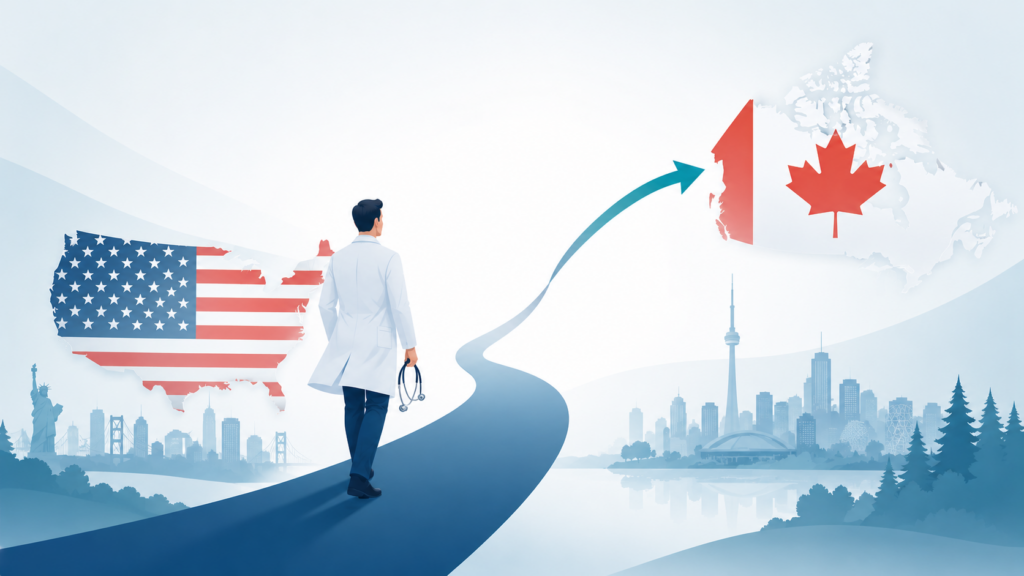
If you’re a U.S.-trained physician thinking about practicing in Canada, there’s a good chance the path is far easier than you expect—especially in the last couple of years. Facing physician shortages, Canadian provinces have moved aggressively to welcome American doctors, and for many, the door is now wide open.
This guide explains how it generally works, the key questions, and where the real friction tends to be. The rules are set province by province and may change. With our personal experience, the transition is quite seamless. With the shortage of doctors in Canada, the US doctors are welcomed in Canada.
The headline: it’s gotten dramatically easier
The single most important development is this: U.S.-trained physicians with American Board of Medical Specialties (ABMS) or American Board of Family Medicine (ABFM) certification can now obtain full, independent licensure in British Columbia, Alberta, Saskatchewan, Manitoba, Nova Scotia, New Brunswick, and Prince Edward Island immediately—with no additional examinations or Canadian certification required. Ontario and Newfoundland and Labrador offer restricted or provisional licenses, with the option to apply for full licensure later.
For a board-certified U.S. physician, that means several provinces will recognize your existing credentials directly. This is a sharp reversal from the historical assumption that practicing in Canada meant repeating exams or training.
How licensure generally works
Canada regulates medicine province by province, so the specifics depend on where you want to practice. But the general framework for a U.S.-trained physician usually looks like this:
- Your U.S. board certification is the key asset. ABMS or ABFM certification unlocks streamlined pathways. If you’re already certified by the ABMS or ABFM, you can obtain full independent licensure in almost every province immediately, with no additional examinations or certification required.
- The province sets the rules. Each provincial medical regulatory authority (such as the College of Physicians and Surgeons of Ontario or the College of Physicians and Surgeons of British Columbia) has its own framework. Most share a similar structure, but supervision requirements and license classes can differ.
- Some provinces phase you in. Ontario, for example, allows a restricted independent practice license limited to your specialty for five years, after which you may apply for a full independent practice license. Others grant full licensure right away.
- Verification still applies. Your degree, training, and certification will be verified—and verified again at hospital credentialing. Documentation is a recurring theme.
What about exams?
For many U.S. physicians, the answer is genuinely “none.” In provinces like Ontario, British Columbia, Nova Scotia, and in fact all others, board-certified U.S. physicians generally don’t need additional exams or training, and there are typically no supervision or assessment requirements for those trained and board-certified in the U.S., within their scope of practice. Physicians who are board-eligible but not yet certified usually have the option to practice under supervision until they complete certification. We have seen this in our personal experiences with US board-certified physicians moving to Canada.
Immigration is a separate process
A crucial point that catches many physicians off guard: licensing and immigration are two completely separate tracks. Being eligible for a Canadian medical license doesn’t grant you the right to work there—you need a valid immigration status, handled through a different process. The encouraging news is that Canada has been actively prioritizing physician immigration. Canada recently announced a new Express Entry category for physicians with Canadian experience, along with dedicated permanent-residence spaces for provincially nominated doctors. Common routes include Express Entry (for permanent relocation), employer-sponsored work permits (if you have a job offer), and provincial nominee programs.
The key is that licensure and immigration should be pursued in parallel, not one after the other.
Where the friction usually shows up
The rules have eased, but people still get stuck—usually on sequencing and specifics rather than eligibility:
- Choosing a province before confirming its exact pathway and license class for your specialty
- Treating licensure and immigration as one process instead of two parallel tracks
- Underestimating credential-verification timelines (and how many times verification repeats)
- Assuming every province handles supervision and license duration the same way—they don’t
- Not accounting for differences like longer Canadian residency lengths in certain specialties when scope-of-practice questions arise
This is an area where IMG Recruitment has extensive expertise, and guidance is available by clicking here.
How to make this simpler
Every physician’s situation is different—your specialty, board certification status, target province, and immigration goals all shape the optimal path. A route that gives one physician immediate full licensure in one province may look entirely different for another specialty or destination.
At IMG Recruitment, we help U.S.-trained physicians map the cleanest path to Canadian practice for their specific situation—identifying the right province, clarifying licensure and certification recognition, and navigating the parallel immigration track. If you’re a U.S.-trained physician considering a move north, we’ll help you figure out your best next step.
This article is for general informational purposes and reflects requirements as of June 2026. Medical licensure and immigration requirements vary by Canadian province and territory and by individual circumstances, and change frequently. Always confirm current requirements with the relevant provincial medical regulatory authority and qualified immigration counsel before making decisions.