
State Licensure Laws Explained: How International Medical Graduates Can Practice in the U.S. Without a U.S. Residency? (2026 Guide)
For decades, the path for an internationally trained physician to practice in the United States ran through one narrow gate: repeat a full U.S. residency, regardless of how many years you’d already practiced as an attending abroad. That gate is starting to open. Since 2023, a growing number of states have passed what are commonly called “additional pathway” state licensure laws—rules that allow experienced foreign-trained physicians to earn a U.S. license through a period of supervised practice rather than repeating residency from scratch. This guide explains what these laws actually do, which states have them, what they require, and the real-world catches most physicians don’t hear about until late in the process.
What “provisional licensure” actually means?
A provisional licensure pathway doesn’t waive U.S. standards—it restructures how you meet them. Instead of completing one or more years of U.S. graduate medical education before licensure, qualifying physicians typically receive a provisional or limited license, practice under supervision at an approved facility for a defined period (often two to four years), and then convert to a full, unrestricted license. According to the Federation of State Medical Boards, the laws vary widely from state to state, but most share a common spine:
– An offer of employment before you apply
– ECFMG certification
– Postgraduate training completed abroad
– An active foreign license, and
– Practice experience depends on each state
Which states have enacted these pathways?
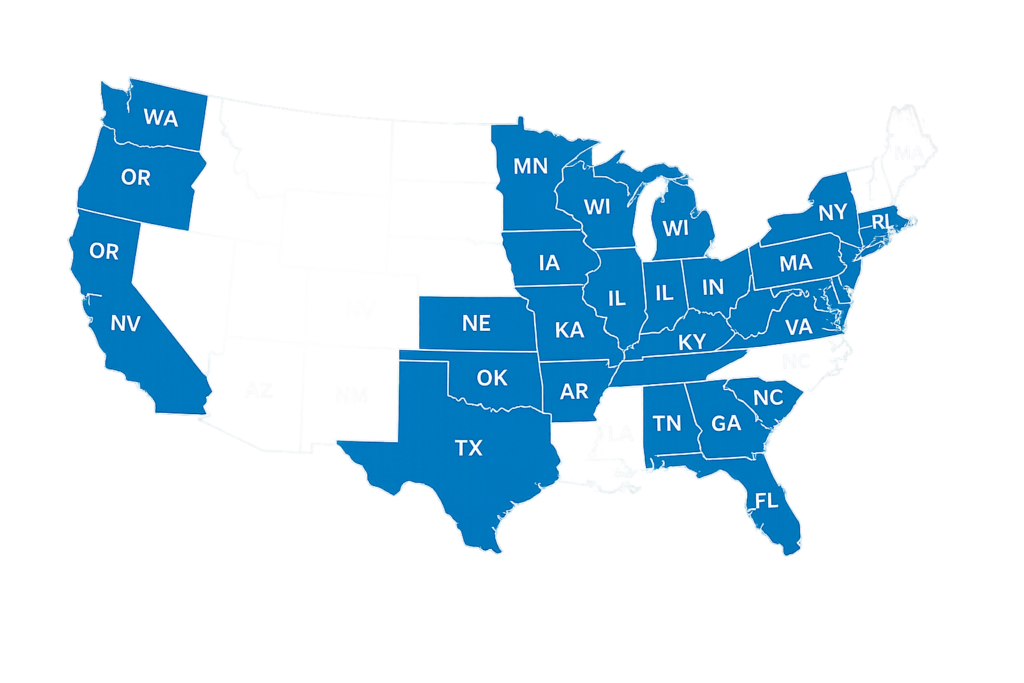
As of early 2026, the FSMB counts roughly two dozen jurisdictions with some form of additional licensure pathway for internationally trained physicians:
- Arkansas
- Florida
- Idaho
- Illinois
- Indiana
- Iowa
- Kentucky
- Louisiana
- Massachusetts
- Minnesota
- Nebraska
- Nevada
- North Carolina
- Oklahoma
- Oregon
- Rhode Island
- Tennessee
- Texas
- Virginia
- Washington
- West Virginia
- Wisconsin
Enacted status varies—some pathways are fully operational, others are enacted but still awaiting the implementing regulations that make them work, and a few are narrow pilots. Always verify with the relevant state medical board.
The distinction matters enormously—an enacted law with no regulations yet is a door that’s been built but not unlocked.
The newest and most notable laws
A few 2024–2026 developments stand out:
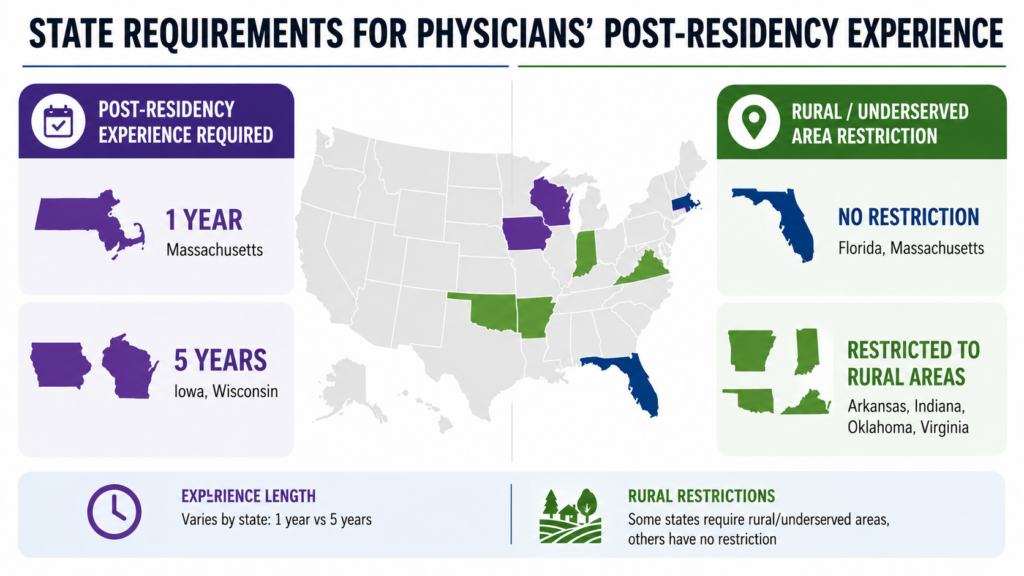
Florida (2024): Allows licensure without a U.S. residency for physicians with an active foreign license, four years of recent practice, ECFMG certification, and a Florida job they must hold for at least two years.
North Carolina (2026): Starting January 1, 2026, allows IMGs to practice under a new Internationally-Trained Physician Employee (ITPE) license without completing a U.S. residency or all USMLE exams—a pathway especially geared toward physicians willing to serve rural areas.
West Virginia (2026): House Bill 5458 removed the U.S. residency requirement for qualifying international graduates, allowing the Board of Medicine to grant a full license to IMGs who meet all standard criteria except U.S. residency; the law took effect June 7, 2026.
Washington (2026): SSB 5185, signed in March 2026, created a Clinical Experience Graduate Pilot Program that allows internationally trained doctors already working in the state to transition from supervised practice to full licensure in primary care after roughly 4 years of supervised practice and passing U.S. licensing exams.
The common requirements you should expect
While the details differ, most bridge laws ask for the same core elements:
- An active and unencumbered license in your home country
- A defined minimum of practice experience (commonly three to five years)
- ECFMG certification and graduation from a recognized medical school
- Postgraduate training completed abroad
- English proficiency
- A confirmed job offer before you apply
Most provisional licenses also restrict you to practicing within a specific employing facility or system until you complete the supervised period. In several states, stepping outside that facility or scope can result in discipline up to and including revocation.
The catches most physicians miss
Three things derail more applicants than anything else:
- The job has to come first. These are not licenses you obtain and then go job hunting with; the employment offer is usually a precondition, making finding the right employer the real bottleneck.
- Enacted is not the same as available. A law passed in 2024 may still be waiting on board regulations in 2026, meaning no one can actually apply yet.
- The supervised period has rules. Where you can work, who must supervise you, and what happens if you change jobs mid-pathway all vary by state and are easy to get wrong in ways that cost years.
How to use this if you’re an experienced international physician
The practical sequence is:
- Confirm which states have a fully operational pathway—not just a passed bill—that matches your specialty and visa situation.
- Verify the specific experience, exam, and certification requirements for your target state.
- Line up an employer willing to sponsor you into a provisional role, since that offer is the gate.
Because the rules shift constantly—new states are added almost every legislative session and existing laws get amended—any list, including this one, should be treated as a starting point to verify against the current state medical board, not a final answer.
Get help navigating your options
At IMG Recruitment, tracking these bridge laws and matching experienced international physicians to employers in states where the pathway actually works is the core of what we do. If you’re an experienced attending trying to figure out which state and which employer fit your situation, reach out to us by clicking here—we’ll help you separate the doors that are open from the ones that only look open.
This article is for general informational purposes and reflects laws as of June 2026. Licensure requirements change frequently and vary by state; always confirm current requirements with the relevant state medical board or qualified legal counsel before making decisions.