
Do Hospitals Need to Sponsor a Visa to Hire an International Physician?
For hospitals and clinics, “do we need to sponsor a visa?” is often the question that stalls an otherwise promising hire of an international physician. The honest answer: sometimes—and it depends entirely on the candidate’s immigration status.
The good news is that the options are more navigable than most hiring teams assume, and some of the biggest perceived obstacles (like the H-1B lottery) don’t even apply to many hospitals. This guide walks through the main categories in simple language.
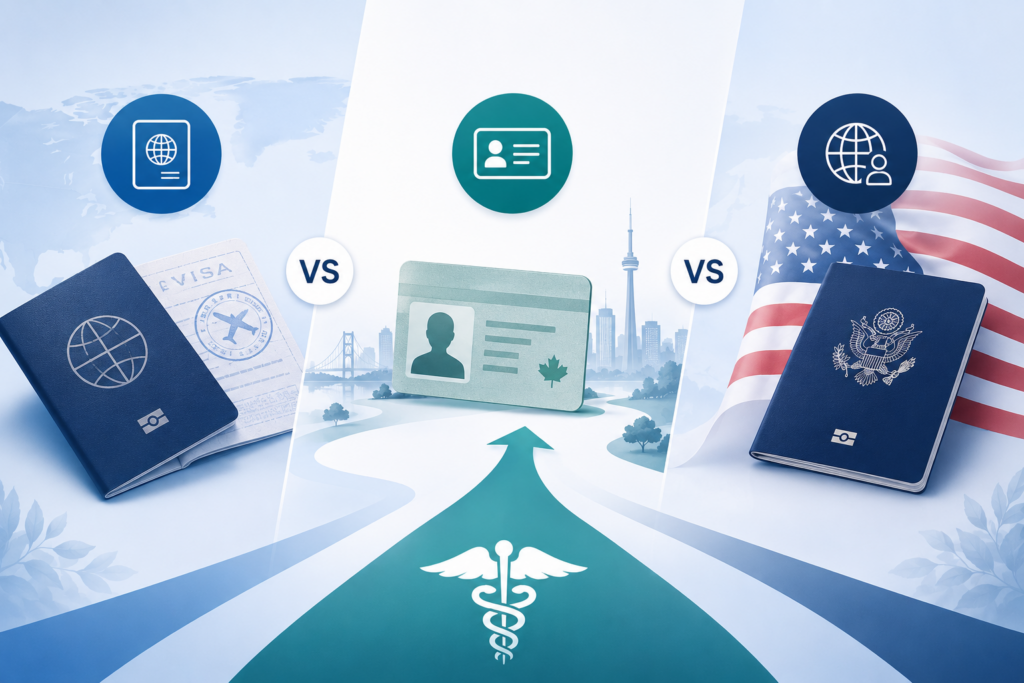
First question: does the candidate even need sponsorship?
Not every international physician requires visa sponsorship. Before assuming a complex process, determine which of these applies:
- U.S. citizens and lawful permanent residents (green card holders): No sponsorship needed. These physicians can be hired exactly like any U.S.-born candidate—no visa petition, no immigration filing. A foreign medical degree does not mean a candidate needs sponsorship; many internationally trained physicians are already citizens or permanent residents.
- Physicians already on a valid work visa: May need a transfer or extension rather than a fresh sponsorship, which is often a different process.
- Physicians needing new sponsorship: This is where J-1, H-1B, and O-1 come in.
So the very first step is simply asking about the current immigration status. A meaningful share of “international” candidates need no sponsorship at all.
The main physician visa categories, compared
Here’s how the three sponsorship routes most relevant to hospitals stack up:
| J-1 (with waiver) | H-1B | O-1 | |
|---|---|---|---|
| What it’s for | Physicians who did U.S. residency/fellowship on a J-1 exchange visa | Specialty-occupation workers, including physicians and surgeons | Individuals with “extraordinary ability” |
| Key catch | Carries a 2-year home-country return requirement that must be waived | Historically subject to an annual cap/lottery—but many hospitals are exempt | High bar; requires substantial evidence of distinction |
| Typical trigger | Hiring a physician finishing U.S. training | Hiring an attending; converting a J-1 waiver physician | Hiring a highly accomplished or research-prominent physician |
| Service obligation | Yes—usually 3 years in an underserved area | None inherently | None |
| Best fit for hospitals | Shortage areas and rural facilities | Most hospital hires and our personal experience | Senior, research-heavy, or distinguished recruits |
J-1 and the waiver: the underserved-area pathway
Many internationally trained physicians complete their U.S. residency on a J-1 exchange visa. That visa carries a requirement to return to the home country for two years after training—but a physician can obtain a waiver by agreeing to practice for at least three years in an area designated as a Health Professional Shortage Area (HPSA), Medically Underserved Area (MUA), or Medically Underserved Population (MUP). The best-known route is the Conrad 30 program. Under it, each U.S. state may recommend up to 30 J-1 physician waivers per year for physicians who commit to at least 3 years of service in an underserved area.
After the waiver, the physician typically moves to H-1B status to do the work. Once the three-year service obligation is complete, the physician can continue with the same employer without the underserved-area restriction, change employers, or pursue a green card. For a rural or shortage-area hospital, this is often the most powerful tool available—and it comes with a built-in retention period.
H-1B: and the cap exemption many hospitals miss
The H-1B is the workhorse visa for some residents, a few clinical fellows, and attending physicians. The common fear is the annual lottery—but here’s the detail that changes the math for many facilities: a hospital can be exempt from the H-1B cap if it is an institution of higher education, a nonprofit affiliated with one, or a nonprofit/governmental research organization. University-affiliated teaching hospitals and nonprofit health systems are especially likely to qualify for cap-exempt status.
Why this matters: cap-exempt petitions can be filed any time of year rather than only in the spring lottery window, and with premium processing, a physician can often start within weeks. Many nonprofit hospitals don’t realize they qualify—an affiliation with a local college, or running a training program, can establish an exemption, so it’s worth investigating institutional relationships carefully. Also worth noting: physicians who got a J-1 waiver through a state health department are themselves exempt from the H-1B cap. In our experience, many physicians have directly transitioned on an H-1B visa, including the author of this article.
O-1: for the distinguished recruit
The O-1 is for physicians with demonstrated “extraordinary ability”—typically those with a strong record of research, publications, awards, or recognition in their field. It has no cap and no underserved-area obligation, but the evidentiary bar is high. For most routine attending hires, it’s overkill, but for a senior academic recruit or a research star, it can be the cleanest option and avoids the J-1 return requirement entirely.
Green card holders and citizens: no sponsorship at all
It bears repeating because it’s so often overlooked: a physician who is a U.S. citizen or lawful permanent resident needs no visa sponsorship whatsoever, regardless of where they trained. And physicians who complete a J-1 waiver and their service obligation frequently go on to obtain permanent residence—sometimes via the EB-2 National Interest Waiver, which their service in an underserved area can strengthen. In other words, today’s sponsored hire is often tomorrow’s green-card holder, which is a strong retention story for hospitals.
In our opinion, the EB-1 remains the best form of green card.
What this means for your hiring strategy
The practical takeaways for a hospital or clinic:
- Always ask about immigration status first—you may not need sponsorship at all.
- Check whether you’re cap-exempt before assuming the H-1B lottery blocks you. Many hospitals qualify and don’t know it.
- For shortage-area facilities, the J-1 waiver is a recruiting superpower—it opens access to a talented candidate pool and includes a multi-year commitment.
- Match the visa to the candidate, not the other way around. The right route depends on their status, training history, and your facility type.
IMG Recruitment can guide you through this process, drawing on our experience guiding many hundreds of international medical graduates.
How IMG Recruitment helps
Visa’s strategy is exactly where good hires fall apart—or come together. We help hospitals and clinics identify which candidates need sponsorship (and which don’t), determine whether your facility qualifies for cap exemption, and match physicians to the visa pathway that fits both their status and your needs—coordinating with immigration counsel so your team isn’t navigating this alone. If you have a role you’re trying to fill, we’ll help you map the cleanest path.
This article is for general informational purposes only and reflects immigration rules as of June 2026. It is not legal advice. or immigration advice, but rather based on personal experiences. Immigration law is complex, changes frequently, and applies differently to each individual and employer. Always consult qualified immigration counsel before making hiring or sponsorship decisions.